Who Builds Data Centers? A Guide to the Largest U.S. Data Center Contractors
Table of contents
When a company announces a new data center, it is easy to assume that company is physically building it. In reality, a major data center is built by a layered network of companies, from the owner who funds it down to the trade contractors who install the electrical and mechanical systems.
This guide walks through that process, explains the major roles involved, and names some of the largest, publicly ranked contractors active in this space. It is meant as a general overview, not a map of any specific project.
Who Is Actually Responsible for Building a Data Center
A single data center typically passes through several layers of responsibility before it is operational. Asking who builds data centers is really asking about a chain of companies, not one builder.
- 1Owner and developer
- 2Engineers and designers
- 3General contractor or construction manager
- 4Major trade contractors, electrical, mechanical, civil, and structural
- 5Specialty trades
- 6Testing and commissioning
- 7Operational data center
Step 1, Owner and Developer
The owner is the company funding and ultimately operating the facility. This may be a hyperscale cloud provider, an AI company, a colocation provider, a data center developer, or an institutional infrastructure investor.
- Capacity and uptime requirements
- Location and schedule
- Power and cooling requirements
- Redundancy and security standards
- Sustainability targets
On the largest campuses, an owner often repeats a standardized design across multiple states. That is why buildings owned by the same company can look and function similarly even when built by entirely different construction teams.
Step 2, Engineers and Designers
Before any craft workers arrive onsite, engineering teams determine how the facility will actually operate. A data center is usually discussed in terms of megawatts of IT capacity rather than square footage, which says a lot about where the real complexity lives.
- Utility service and substations
- Medium voltage distribution
- Backup generation and UPS systems
- Switchgear and mechanical cooling
- Controls and fire protection
- Structural and architectural systems
Step 3, General Contractor or Construction Manager
This is the role most people mean when they ask who builds data centers. Data center general contractors oversee the overall project and coordinate dozens, sometimes hundreds, of other companies.
- Overall project schedule and site logistics
- Safety and quality management
- Subcontractor coordination and procurement
- Construction sequencing and cost control
- Owner communication and turnover
Major U.S. Data Center Contractors
ENR's 2026 Top 400 Contractors ranking shows just how significant mission critical construction has become. Overall Top 400 contractor revenue rose 11.8 percent in 2025, with the surge in data center work cited as a major driver. These are general, publicly ranked overall contractor standings, not a ranking of current data center specific work.
Turner Construction. Ranked number one overall on ENR's 2026 Top 400 list. One of the largest construction companies in the country, with a major presence in technically complex, mission critical construction.
DPR Construction. Ranked number seven nationally. Known for delivering complex, mission critical facilities across sectors including advanced technology and healthcare, where precise construction and commissioning matter most.
The Whiting Turner Contracting Company. Ranked number five nationally. Long involved in large scale commercial, technology, and mission critical construction, with a strong footprint across many regions experiencing rapid data center growth.
Mortenson. Ranked number ten nationally. Notable for exposure to both buildings and power and energy infrastructure, which is increasingly relevant as modern campuses tie directly into generation, substations, and battery storage.
Holder Construction. Ranked number twelve nationally. A major name in technically demanding, mission critical construction.
HITT Contracting. Ranked number eight nationally. Particularly prominent in mission critical work on the East Coast.
Several other firms also have significant national construction capabilities in this space, including Hensel Phelps, Clark, Clayco, JE Dunn, Brasfield and Gorrie, and Kiewit. There is no single contractor that builds America's data centers. Contractor involvement varies by geography, owner relationship, facility type, schedule, and project phase.
Contractor participation varies by project and location. This guide is intended as a general overview of companies publicly active in large U.S. mission critical construction and is not a representation of any project's current contracting team.
What Trade Contractors Actually Build
A general contractor manages the project, but most of the physical work is performed by specialized trade contractors working under their own scopes.
Electrical contractors typically install
- Conduit, cable tray, and feeders
- Switchgear, transformers, and busway
- Grounding, lighting, and equipment power
- Controls and medium voltage systems
Mechanical contractors typically build
- Chillers, cooling towers, and piping
- Pumps and air handling equipment
- Liquid cooling and building controls
Civil contractors typically handle
- Grading and underground utilities
- Roads and foundations
- Stormwater and site preparation
Structural contractors erect steel, precast components, and equipment supports. Specialty contractors cover fire alarm, fire protection, security, low voltage, telecommunications, and testing.
Why Electrical Contractors Play Such a Large Role
Modern data centers are effectively enormous electrical facilities wrapped inside a building. Power typically flows from a utility or generation source into a substation, then through medium voltage distribution, into transformers and switchgear, into UPS and backup systems, through power distribution equipment, and finally to server racks.
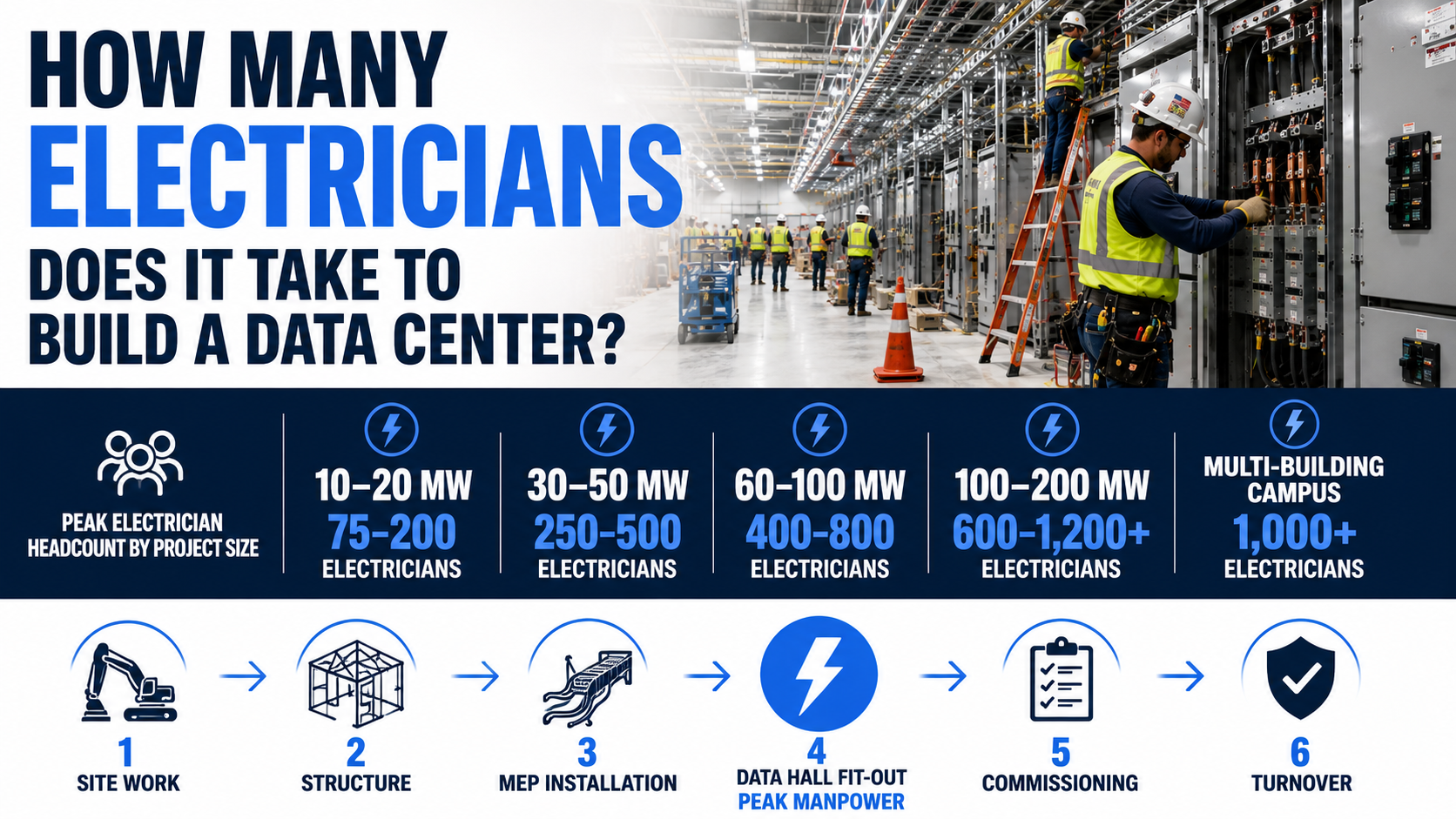
Every layer has redundancy requirements, often multiplied across multiple substations, hundreds of generators, and enormous UPS and battery capacity. That is why data center electrical contractors and skilled electrical labor make up such a large share of data center construction.
How Contractors Are Selected
Large projects are not won through advertising. Selection typically follows a structured process.
- Prequalification, evaluating financial strength, safety performance, and workforce capacity
- Bidding or negotiated procurement, depending on the project
- Safety review, since mission critical projects often carry demanding safety expectations
- Staffing and schedule evaluation, since a contractor may be capable but lack enough available workers for the timeline
- Quality and commissioning experience, since owners need companies that can properly test and document systems, not just install them
Why One Campus Can Have Multiple Contractors
On a large campus, one contractor does not necessarily control every building. A developer might divide work by building, phase, geographic area, or infrastructure package.
A single multibillion dollar campus can involve hundreds of companies and thousands of craft professionals working at once, each operating under a different contractor's scope.
What Makes Data Center Construction Different
Building a warehouse and building an AI data center are very different undertakings. The data center construction process rewards contractors that excel in a few specific areas.
- Schedule, since owners often want multiple buildings delivered extremely quickly
- Procurement, since equipment like transformers, switchgear, and generators can have long lead times
- Quality, since improper installation can delay commissioning of equipment worth hundreds of millions of dollars
- Safety, since thousands of workers can be onsite at once
- Commissioning, since every critical system must function individually and together before turnover
- Scalability, since the same team often repeats a standardized building design across a campus
General Contractor Versus Electrical Contractor
These two roles are often confused. A general contractor or construction manager controls and coordinates the overall project, while an electrical contractor executes the electrical portions of the work under its own awarded scope.
- Project managers and superintendents
- General foremen and foremen
- Licensed journeymen and apprentices
- QA and QC personnel
- Safety professionals
- Commissioning specialists
The Skilled Labor Behind America's Data Center Boom
ENR has described the current market as pushing major contractors up against a craft ceiling, meaning demand for skilled labor is growing faster than the workforce available to meet it.
Building a data center ultimately depends on four things coming together: capital, power, contractor capacity, and skilled labor. A project can have the land, financing, and equipment fully lined up, and the schedule will still slip if the construction market cannot produce enough experienced electricians, foremen, and commissioning personnel.
Data center construction jobs are opening across the country as new campuses break ground.
Apply to work on projects like theseConclusion
A data center is never built by one company. It is built by an owner setting requirements, engineers designing systems, a general contractor coordinating the project, and a wide network of trade contractors executing the actual work.
Electrical contractors sit at the center of that process, since power is the foundation everything else depends on.
Finish Line mobilizes vetted electricians, foremen, and commissioning crews for mission critical builds nationwide.
Get workforce solutions for your next project