Largest U.S. Data Center Projects Expected to Break Ground in Late 2026 and 2027
Table of contents
AI infrastructure is shifting from projects measured in hundreds of megawatts to campuses measured in multiple gigawatts. Goldman Sachs projects U.S. data center power demand will nearly double, from about 31 gigawatts in 2025 to about 66 gigawatts in 2027.
But schedules move fast in this industry. Goldman Sachs estimates only 50 to 60 percent of near term data center capacity will actually come online on time, and satellite analysis found more than half of expected 2027 capacity had not even begun land clearing as of early August 2026. This list focuses on upcoming data center construction projects with credible, verifiable signals, not speculative announcements.
1. Paducah American Energy Hub, Kentucky
Project schedules reflect publicly available information as of August 2026 and remain subject to permitting, utility availability, financing, and construction delays.
- Developer: Brookfield, with NextEra Energy building the power infrastructure
- Investment: up to 100 billion dollars
- Capacity: more than 1.2 gigawatts, with up to 4.6 gigawatts of dedicated generation
- Construction jobs: approximately 8,000
- Target: operational 2028, full buildout 2032
This may be the single most important project on this list. It redevelops the former Department of Energy Paducah Gaseous Diffusion Plant, a site that already has major transmission lines, water, fiber, and industrial land in place.
What makes this different is scope. It is not just a data center. It combines data centers, substations, transmission, generation, and battery storage in one build, meaning work across nearly every electrical discipline from medium voltage to commissioning. Workforce significance: 10 out of 10.
2. Project Camellia, Georgia
- Developer: OpenAI, inside the Savannah Gateway Industrial Hub
- Investment: 20 billion dollars or more
- Capacity: 3.2 gigawatts across four buildings of about 720,000 square feet each
- Power delivery: 2028 through 2032
- Status: still in permitting, construction has not started
OpenAI revealed Project Camellia in July 2026 with a contract for 3.2 gigawatts of power from Georgia Power. As of early August, Effingham County confirmed the project still needs to clear permitting, stormwater, and safety reviews before construction begins.
That makes this a strong candidate for late 2026 or 2027 site work, with major vertical construction likely stretching well past 2027. At this scale, expect enormous demand for medium voltage distribution, switchgear, generators, controls, and commissioning. Workforce significance: 10 out of 10.
3. Microsoft Pecos AI Campus, Texas
- Developer: Microsoft, with Chevron supplying power through Energy Forge One
- Capacity: approximately 2 gigawatts, up to 2.67 gigawatts of dedicated generation
- Construction jobs: more than 6,000 at peak
- Power target: 2028
Microsoft calls Pecos one of the largest single capacity additions in company history. The twenty year power deal with Chevron means the power plant and the data center are being built together, a model that is quickly becoming the industry standard for gigawatt scale campuses.
That pairing dramatically increases the electrical scope compared to a typical grid connected campus. Workforce significance: 10 out of 10.
4. EdgeConneX Cedar Creek Campus, Texas
- Developer: EdgeConneX, southeast of Austin in Bastrop County
- Investment: approximately 1.4 billion dollars across two buildings
- Construction start: September 1, 2026
- Completion target: March 2029
This is likely the clearest, most literal late 2026 groundbreaking on this list, with an actual filed construction start date rather than a conceptual timeline. It adds to an already competitive labor corridor stretching from Austin through Taylor and Bastrop to San Antonio. Workforce significance: 9 out of 10.
5. Microsoft SAT93 and SAT94, Texas
- Developer: Microsoft, expanding its San Antonio footprint in Medina County
- Two buildings, approximately 245,000 square feet each
- Construction start: spring 2027
- Completion: 2029
Smaller in scale than Camellia or Pecos, but these projects offer a specific, credible 2027 construction window in a market that already has an established mission critical contractor base. Workforce significance: 8.5 out of 10.
6. Buckeye Technology Park, Arizona
- Developer: Tract, on 2,069 acres in Buckeye
- Potential investment: approximately 20 billion dollars
- Potential capacity: up to 1.8 gigawatts across up to 40 buildings
Site preparation and horizontal infrastructure are already underway. The better way to describe this one is horizontal development in progress, with major vertical construction expected to follow. Workforce significance: 9 out of 10.
Mega Projects Worth Watching, Not Yet Ranking
A few announced projects are simply too early to forecast with confidence. Quantica Big Sky Digital Campus in Montana has floated interconnection requests as high as 7.235 gigawatts, but its first building is not expected until closer to 2029. Stratos in Utah is targeting similarly massive scale, but its construction timeline remains fluid.
Beyond these two, dozens of other multi gigawatt announcements exist. Some will happen as planned. Some will shrink, move, or stall out waiting on power. That uncertainty is part of this story, not a footnote to it.
Power Is the Real Bottleneck
Across almost every project on this list, land was the easy part. Securing several hundred megawatts, or multiple gigawatts, of reliable power is what actually determines the timeline. Goldman Sachs expects total U.S. data center demand to roughly double by 2027, and Virginia, Texas, and Georgia currently lead the country in planned capacity.
That is why projects like Pecos and Paducah pair data centers directly with new generation and storage instead of simply connecting to the existing grid, a shift that adds entire new categories of electrical work on top of traditional data center scope.
What This Means for Electrical Contractors
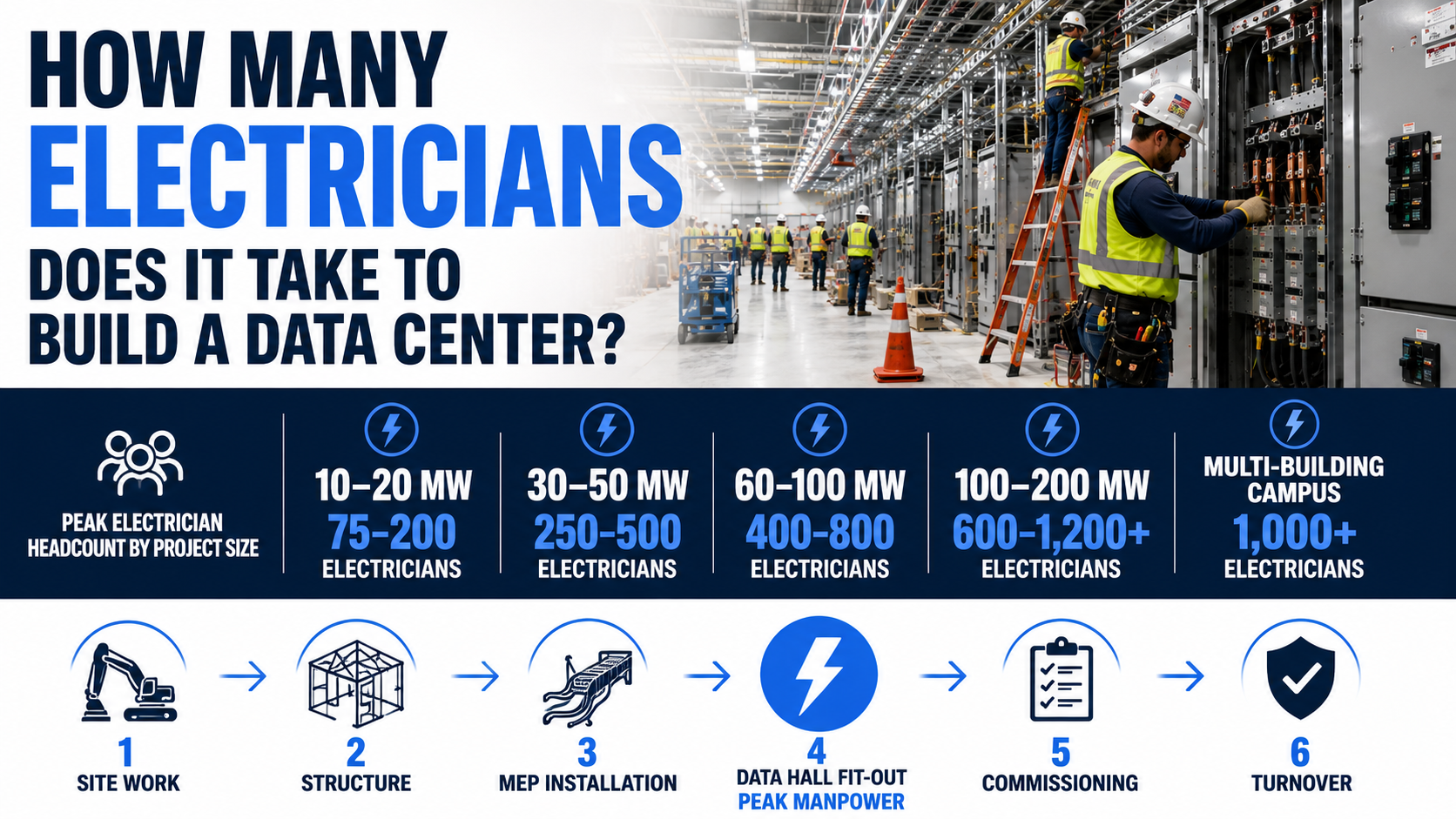
The largest data centers under construction today all compete for the same crews. Data center electrical contractors staffing these campuses will need a wide range of talent, including:
- Licensed journeyman electricians for power distribution and terminations
- Electrical foremen and general foremen managing large crews
- Medium voltage electricians for substations and campus scale generation
- QA and QC electricians for testing and turnover
- Commissioning technicians
- Safety coordinators, especially those with OSHA 510 or 500 and CHST credentials
- Instrumentation and controls technicians, particularly on projects with onsite generation
The Shortage Could Intensify
These projects are not being built one at a time, they are being built at the same time. Technology companies are already investing in workforce development to help close the gap. Capital and equipment can be secured quickly. Experienced journeyman electricians, foremen, and commissioning technicians cannot be manufactured on the same timeline.
AI data center construction is creating some of the best paying data center electrician jobs in the country right now.
Apply to work on projects like theseConclusion
The next wave of AI infrastructure construction is becoming as much a power and workforce story as a data center story. Late 2026 and 2027 could bring one of the largest simultaneous buildouts of mission critical electrical infrastructure in U.S. history, and the limiting factor may be the skilled workforce available to build it.
Finish Line mobilizes vetted electricians and crews on data center projects 2027 schedules depend on.
Get workforce solutions for your next project