How Many Electricians Does It Take to Build a Data Center?
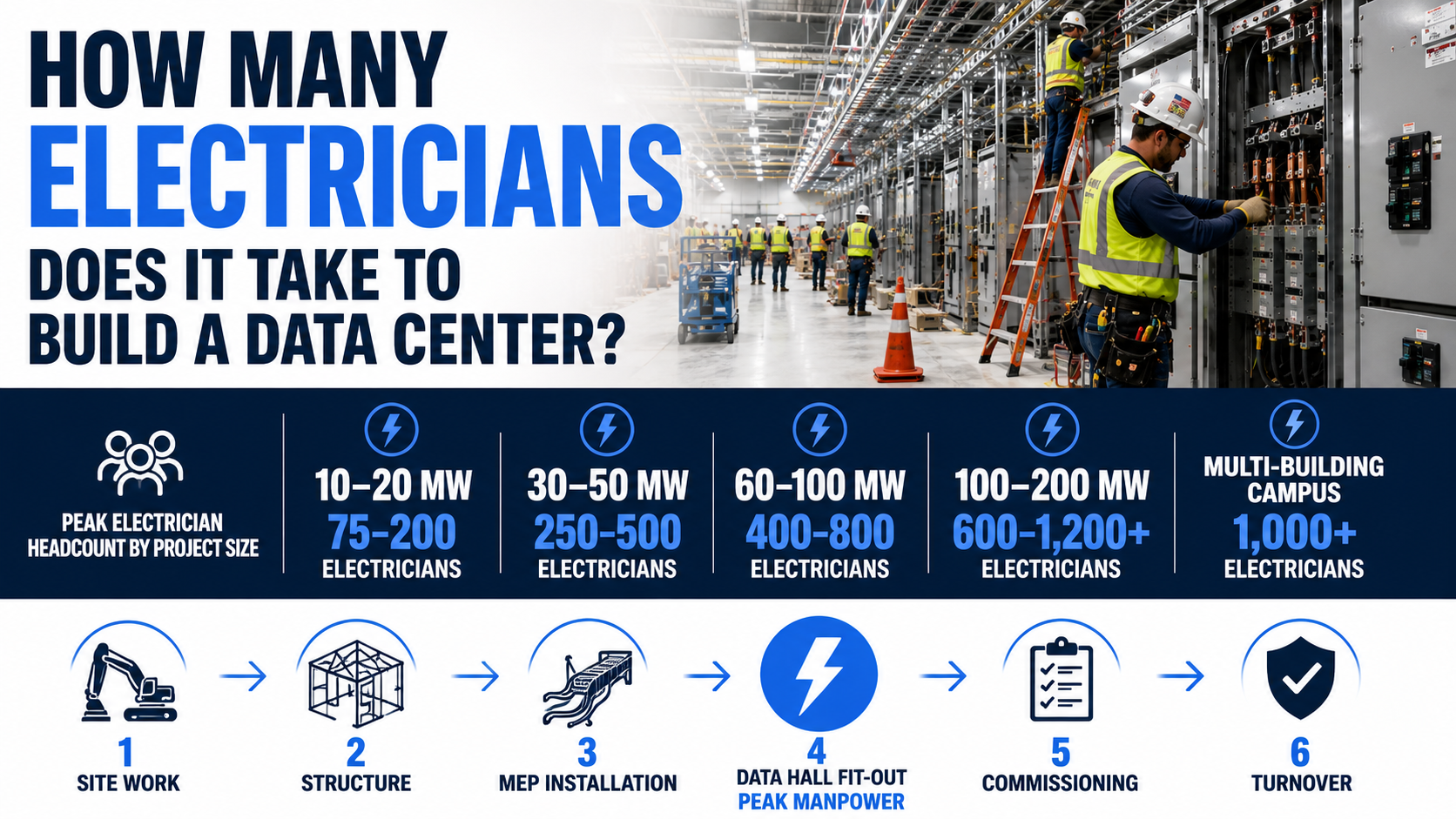
Table of contents
A large hyperscale data center can require hundreds of electricians at peak construction, and the biggest multi building campuses can require well over 1,000 electrical workers across the site. One industry estimate puts a conventional 40 megawatt project at roughly 400 to 500 electricians on site during peak electrical construction, while another workforce benchmark estimates electricians account for 30 to 40 percent of total labor hours on a typical data center build, well above a normal commercial building.
Data centers are among the most electrically intensive buildings in commercial construction. The rest of this guide explains why, and what actually determines whether a project needs 200 electricians or 800.
The Short Answer
| Data Center Size | Approximate Peak Electricians |
|---|---|
| 10 to 20 megawatts | 75 to 200 |
| 30 to 50 megawatts | 250 to 500 |
| 60 to 100 megawatts | 400 to 800 |
| 100 to 200 megawatt campus phase | 600 to 1,200 or more |
| Multi building hyperscale campus | 1,000 or more across active phases |
Illustrative planning ranges for how many electricians it takes to build a data center by megawatt capacity. These are planning ranges synthesized from public workforce benchmarks and typical build examples, not contractual staffing ratios or an industry standard. One workforce guide estimates a 60 megawatt hyperscale building at 500 to 800 total construction workers, while another industry source puts a conventional 40 megawatt facility alone at 400 to 500 electricians during its heaviest electrical phase. That variation is worth understanding, since headcount depends heavily on how a project is actually built.
So, how many electricians does it really take? A smaller data center may require fewer than 100 electricians during its busiest phase. A typical large hyperscale building can require several hundred. A massive multi building AI campus can require 1,000 or more electricians across simultaneous phases. The final number depends on megawatts, design, schedule, prefabrication, redundancy, and how many buildings are being built at once.
Why Data Centers Require So Many Electricians
A conventional warehouse needs lighting, receptacles, panels, fire alarm, and normal building power. A data center has all of that, plus an enormous redundant power system whose entire purpose is keeping computing equipment energized continuously.
- Utility service and substations
- Medium voltage distribution and transformers
- Switchgear, generators, and automatic transfer switches
- UPS systems and batteries
- Busway, PDUs, and RPPs
- Grounding, feeders, and cable tray
- Controls and equipment connections
- Lighting and normal building power
A normal commercial building is electrically served. A data center is essentially an electrical infrastructure project with a building around it. Nearly every critical system has redundancy built in, which is why electrical labor becomes such a large share of the total construction workforce.
When Electrical Manpower Peaks
The electrician count on a project is never constant. A project might eventually need 500 electricians, but it will not have 500 people there on day one.
- Early construction, electrical staffing is light, focused on temporary power, underground duct banks, grounding, and site electrical infrastructure, while civil and structural crews dominate
- Building enclosure and equipment installation, electrical manpower begins climbing as crews install overhead conduit, cable tray, electrical rooms, switchgear, and transformers
- Electrical peak, headcount can explode as multiple crews simultaneously install conduit, pull feeders, terminate cable, wire equipment, and complete data halls
- Commissioning and turnover, raw installation headcount decreases while demand shifts toward QA and QC, testing, commissioning, troubleshooting, and startup
- 1Site work, low
- 2Structure, growing
- 3MEP installation, high
- 4Data hall fit out, peak
- 5Commissioning, specialized
What Determines Electrical Headcount
Two data centers of the same size can carry very different electrical labor data center curves. These are the factors that move the number most.
Megawatt capacity
More megawatts generally means more electrical infrastructure, but the relationship is not perfectly linear. A 100 megawatt project does not necessarily need exactly twice the electricians of a 50 megawatt project, since design, prefabrication, schedule, and equipment choices all matter.
Construction schedule
The question is not only how much electrical work exists, it is how quickly that work has to be installed. Two identical facilities can require very different peak workforces. A project with 30 months to finish and one with 18 months for the same scope may need dramatically different numbers of electricians working at the same time.
Prefabrication
Modern data center contractors are increasingly using modular electrical skids, prefabricated racks, preassembled conduit systems, and factory integrated equipment, which can meaningfully reduce onsite labor. Industry analysis of a conventional 40 megawatt build specifically points to increased offsite fabrication as a way to reduce onsite electrical headcount, meaning future data centers may grow larger without field electrician counts rising at the same rate.
Design redundancy
More redundancy means more gear, more feeders, more generators, more switching, and more testing, which means more electrical labor. A mission critical facility built to a higher redundancy standard will typically need a larger electrical workforce than a less redundant design of similar size.
Onsite generation
Some campuses are no longer just building a data center, they are building a data center, a power plant, a substation, and battery storage together. That adds demand for medium voltage and high voltage personnel, instrumentation technicians, controls electricians, commissioning technicians, and substation specialists, meaning a large AI campus can require a broader electrical workforce than a traditional building connected entirely to utility power.
Number of buildings under construction simultaneously
This is how a single site reaches 1,000 or more electricians. On a six building campus, one building might be commissioning while another is terminating feeders, another is pulling cable, another is installing conduit, and another is just coming out of the ground.
Each building has its own crews, so campus level headcount can become enormous even when no single building has 1,000 electricians on it. A headline describing a large gigawatt scale campus usually reflects a multi year sequence of phases, not one building built all at once.
What Types of Electricians Work on Data Centers
A data center electrical workforce is not one large group of identical journeymen, it includes several distinct roles. Data center staffing plans usually account for each of them separately.
- Journeyman electricians, the core installation workforce handling conduit, feeders, cable tray, equipment, terminations, and grounding
- Apprentices, working under licensed supervision on significant portions of installation
- Foremen, running individual crews and work areas
- General foremen, coordinating multiple crews and foremen
- Electrical superintendents, overseeing major portions of the electrical program
- Medium voltage and high voltage electricians, increasingly important as campus power systems grow
- QA and QC electricians, verifying installations against drawings, specifications, and testing standards
- Commissioning personnel, proving that critical systems function correctly before turnover
A data center is not complete simply because every wire is installed. The entire power system has to work together under both normal and failure conditions, which is why commissioning has become its own specialized phase of the project.
How Many Total Workers Does a Data Center Require
Public examples show how quickly the data center construction workforce scales. Microsoft has said its data center construction projects can support thousands of workers, and more than 1,300 skilled trades workers were building Microsoft facilities in Washington alone in early 2026. One Microsoft project presentation cited roughly 300 to 400 construction jobs for a single development, with especially strong demand for electricians and HVAC workers.
At the other extreme, today's largest AI campuses can create construction workforces measured in the thousands, or even tens of thousands, across multiple phases. This is why a single, universal workers per data center number is misleading.
Why Electricians Are Becoming a Construction Bottleneck
Microsoft said directly in January 2026 that the AI construction boom is creating intense competition for a limited skilled trades workforce, citing an Associated Builders and Contractors estimate that the construction industry was short approximately 439,000 workers, heavily concentrated among skilled crafts.
Meta has responded with a 115 million dollar workforce training initiative aimed at skilled trades supporting AI data center construction, a program expected to train thousands of workers. Technology companies that once worried primarily about chips, fiber, land, and power are now investing directly in training electricians, pipefitters, welders, and other skilled construction workers.
That alone signals how much of a strategic constraint labor has become, and why data center electrician jobs stay open even in competitive markets.
Can Prefabrication Reduce the Number of Electricians Needed
To some degree, yes. Increased offsite fabrication, including modular skids and preassembled conduit systems, can reduce the amount of labor required in the field. But prefabrication shifts where labor happens more than it eliminates the need for it, and it does not reduce the need for experienced electricians to install, terminate, and commission that equipment once it arrives onsite.
What the AI Data Center Boom Means for the Electrical Workforce
You can hire and train many construction positions relatively quickly. You cannot instantly create an experienced journeyman electrician. Reaching journeyman level typically requires thousands of supervised working hours, years of experience, coursework, testing, and state licensing, and licensing requirements differ across state lines.
So even though the United States has hundreds of thousands of electricians overall, that does not mean those workers are licensed in the right state, available, experienced with data center work, willing to travel, or able to start immediately. That gap between raw numbers and truly deployable talent is the real constraint behind the AI infrastructure buildout.
Conclusion
The challenge is not simply finding enough construction workers. It is finding enough experienced electrical professionals with the right skills, licensing, and availability at the exact point a project reaches peak electrical construction. As data centers keep growing in scale and speed, that challenge is only becoming more central to how fast this industry can actually build.
Finish Line places licensed electricians, foremen, and commissioning technicians on data center and mission critical projects nationwide.
Apply to work on projects like theseBuilding a data center and need electrical manpower at peak? We mobilize crews of 10 to 500 tradespeople per site.
Get workforce solutions for your next project