How to Get Your Journeyman Electrician License
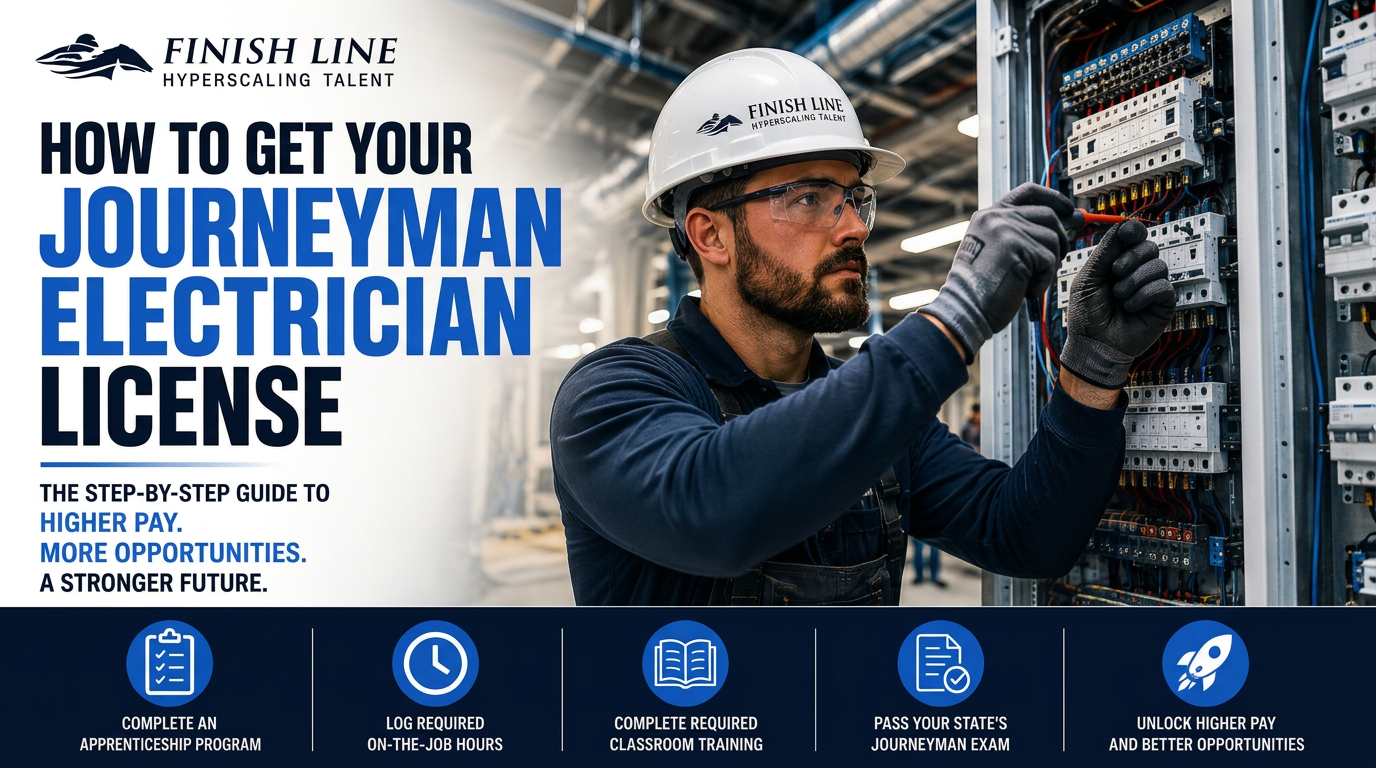
Table of contents
A journeyman electrician license is the single biggest pay jump most electricians will ever make. It is the credential that separates a helper on a jobsite from a tradesperson who can pull permits, run work, and command top scale on data center, semiconductor, and industrial projects.
This guide walks through exactly what the license is, the hours and coursework you need, how the exam works, and how the rules shift from state to state. If you are already close, skip to the state section; if you are starting from zero, start at the top.
What Is a Journeyman Electrician License?
A journeyman electrician license is a state or local credential certifying that you can install, alter, and repair electrical systems without direct supervision. It sits between apprentice (learning under supervision) and master electrician (able to design systems, pull permits in most jurisdictions, and supervise others).
Licensing is issued at the state level in most of the country, but a number of states delegate it to counties or cities. Wherever you hold it, the license proves three things to a contractor: documented field hours, classroom training in the National Electrical Code, and a passing score on a proctored exam.
- Work unsupervised on commercial, industrial, and residential systems
- Qualify for journeyman scale, per diem, and travel packages on large projects
- Supervise apprentices and helpers on the jobsite
- Build eligibility toward a master electrician license
Step 1: Complete an Apprenticeship Program
Nearly every state requires a formal apprenticeship, or a documented equivalent, before you can sit for the journeyman exam. Apprenticeships pair paid field work with classroom instruction and typically run four to five years.
Where apprenticeships come from
- Union programs (IBEW/NECA JATC) with structured wage steps and classroom nights
- Non-union or merit-shop programs run by contractors, IEC, or ABC chapters
- Community college or technical school programs paired with an employer sponsor
- State-registered apprenticeships through your Department of Labor
You do not need a license to start earning. Many electricians begin as helpers on large commercial projects and log hours toward their license while they work.
Finish Line places helpers, apprentices, and licensed electricians on data center and industrial projects nationwide, with top pay and per diem.
Apply for electrician workStep 2: Log Required On-the-Job Training Hours
On-the-job training (OJT) hours are the backbone of your application. Most states require between 6,000 and 8,000 documented hours, which works out to roughly four years of full-time field work.
- Typical requirement: 8,000 hours (four years) of supervised electrical work
- Lower-threshold states: 4,000 to 6,000 hours, often with extra classroom hours
- Hours usually must be verified and signed off by a licensed master or the employer of record
- Some states cap how many hours count from residential-only or low-voltage work
Track your hours from day one. Keep pay stubs, employer letters, and a personal log with dates, jobsites, license number of your supervisor, and the type of work performed. Reconstructing five years of hours after the fact is the most common reason applications stall.
Step 3: Complete Required Coursework and Classroom Hours
Alongside field hours, states require classroom instruction, generally 144 hours per year of apprenticeship, or 576 to 900 hours in total. Coursework centers on the National Electrical Code (NEC), electrical theory, blueprint reading, conduit bending, motor controls, and jobsite safety.
- NEC code study, updated on the three-year revision cycle
- AC/DC theory, load calculations, and ohm's law applications
- Grounding and bonding, raceway and conduit fill
- OSHA 10 or OSHA 30 safety training, often required for site access
Save your transcripts and certificates of completion. Licensing boards ask for them as proof, and contractors on mission critical projects frequently ask for OSHA and NFPA 70E cards before badging you in.
Step 4: Pass Your State's Journeyman Exam
The journeyman exam is a proctored, mostly open-book test administered by a third party such as PSI or Prov. Expect 80 to 100 multiple-choice questions over roughly four hours, with a passing score around 70 to 75 percent.
What the exam covers
- NEC code lookups: wiring methods, conductors, boxes, and services
- Load and conduit fill calculations
- Grounding, bonding, and overcurrent protection
- Motors, transformers, and special occupancies
- State-specific law and business rules on some exams
How to prepare
- 1Confirm which NEC edition your state has adopted, then buy that exact code book.
- 2Tab and highlight your code book so lookups take seconds, not minutes.
- 3Work timed practice exams until calculations are automatic.
- 4Take a state-specific prep course if your state includes a law portion.
Most candidates who fail run out of time, not knowledge. Speed in the code book is the skill that gets tested.
How Requirements Vary by State
There is no national journeyman license. Requirements, hour counts, and reciprocity agreements are set state by state, and a handful of states license only at the city or county level.
- Statewide licensing: most states issue and renew a single journeyman card valid everywhere in the state.
- Local licensing: some states leave licensing to municipalities, so a city card may not travel across county lines.
- Reciprocity: many states honor another state's journeyman license if the hour requirements are comparable, sometimes without retesting.
- Continuing education: renewals commonly require four to sixteen hours of code update training every one to three years.
Before you travel for work, verify both the license requirement and whether your current card reciprocates. Our recruiters keep a state-by-state reference for lookups and reciprocity so you are not guessing before a mobilization.
How Long Does It Take?
For most electricians, four to five years from first day as an apprentice to a journeyman card in hand. The variables are how consistently you work and how quickly your state processes applications.
- Apprenticeship and OJT hours: 4 to 5 years
- Classroom instruction: completed concurrently, 144 hours per year
- Application review and approval: 2 to 8 weeks
- Exam scheduling and results: often same-day scoring, 1 to 4 weeks to receive the card
The fastest path is steady hours. Long gaps between jobs are what stretch a four-year timeline into six. Working on large commercial and industrial projects with heavy schedules is the single most effective way to bank hours quickly.
What Comes After Journeyman? (Path to Master Electrician)
A master electrician license typically requires two to four additional years of documented experience as a licensed journeyman, plus a more demanding exam covering design, code administration, and business law.
- Pull permits and sign off on installations in most jurisdictions
- Design systems and stamp plans where state law allows
- Qualify a contracting license and run your own shop
- Move into foreman, general foreman, and superintendent roles at higher scale
Many electricians also add specialty credentials along the way, including low-voltage, fire alarm, instrumentation, and NFPA 70E arc flash training, all of which raise your value on mission critical projects.
Ready to Put Your License to Work?
Finish Line places electricians at every level, from helpers logging their first hours to licensed journeymen and masters, on data center, semiconductor, and industrial projects across the country. Top pay, per diem, and long-run schedules that let you bank hours fast.
Apply in a few minutes from your phone and a recruiter will reach out with current openings.
Apply now